
Notary Public Act Nepal 2063 (2007): The Complete Guide to Document Notarization in Nepal
Expert Insights on Legal Document Certification, Attestation & Translation Services by Qualified Advocates & Notary Public in Nepal
Introduction: Why Document Notarization Matters in Nepal
In an era of unprecedented global mobility, whether you are pursuing international business opportunities, seeking higher education abroad, or planning migration, the authenticity of your legal documents is your most valuable asset. In Nepal, the Notary Public Act, 2063 (2007) serves as the definitive legal framework ensuring that your documents are recognized both domestically and by foreign authorities worldwide.
Before the enactment of this landmark legislation, document verification in Nepal was fragmented and inconsistent. The process was often handled by various government officials or commercial banks without a unified system, leading to significant delays, inconsistencies, and potential fraud. Today, the Notary Public Act provides a professional, regulated structure for document certification, attestation, and translation that meets international standards.
For reliable information about notarization in Nepal, qualified advocate/Notary Public services, and expert legal guidance, visit our trusted partner websites: Kiplan Law and Notary in Nepal. These platforms provide comprehensive resources for all your notarization needs in Kathmandu and across Nepal.
The Legal Framework: Understanding the Notary Public Act, 2063
Purpose and Mission of the Act
The Preamble of the Notary Public Act, 2063 explicitly states its mission: to establish comprehensive legal provisions regarding the Notary Public, confirm the identity of individuals during document preparation, and prevent fraudulent activities that could undermine the integrity of legal documentation in Nepal.
The Nepal Notary Public Council (NNPC)
The Act established the Nepal Notary Public Council, an autonomous body overseen by the Attorney General’s Office. The Council serves as the “gatekeeper” of the notary profession in Nepal, responsible for maintaining the highest standards of legal documentation.
Key responsibilities of the NNPC include:
- Formulating strict codes of conduct and professional regulations for all notaries
- Conducting rigorous examinations for licensing and certification
- Monitoring the performance and ethical standards of all licensed notaries
- Maintaining the national register of authorized practitioners
- Investigating complaints and taking disciplinary action when necessary
For official information about the Nepal Notary Public Council and regulatory updates, visit: https://notarypublic.org.np/.
Understanding Notary Classifications in Nepal
Under the Notary Public Act, 2063, notaries in Nepal are classified based on their specific authority and qualifications. It is crucial for clients to understand which type of professional they need for their specific legal requirements.
General Notary vs. Translator Notary: Key Differences
| Feature | General Notary | Translator Notary |
| Qualification | Bachelor’s Degree in Law + 7 years of legal practice | Bachelor’s Degree in Law + 7 years of legal practice |
| Licensing | Application based on Advocate license & experience | Must pass a rigorous translation examination (English/Nepali) |
| Primary Function | Attestation of ‘True Copies’ and certification of signatures | All General functions PLUS official translation of legal documents |
| Document Types | Contracts, affidavits, power of attorney, certificates | Legal translations, bilingual contracts, international documents |
| Validity | 5 Years (Renewable) | 5 Years (Renewable) |
For professional translation and notarization services in Kathmandu, visit Notary in Nepal to connect with certified translator notaries.

The Notarization Process in Nepal: Step-by-Step Process
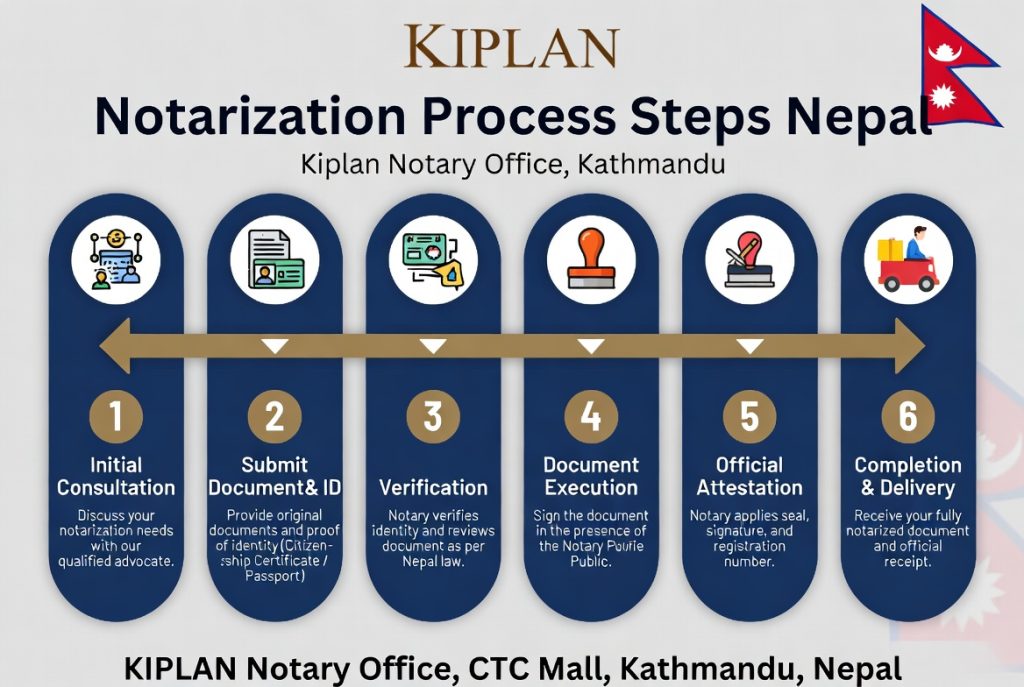
If you require document certification in Nepal, you must follow a formal legal procedure. There are no shortcuts to legal validity. Understanding this process will help you prepare your documents correctly and avoid unnecessary delays.
Step 1: Physical Visit: You must visit a licensed law firm or notary office in person. The Notary Public Act, 2063 mandates physical presence before the notary.
Step 2: Original Document Verification: The notary must compare your copies against original documents (Citizenship Certificate, Academic Transcripts, Contracts, etc.).
Step 3: Identity Confirmation: You must present a valid government-issued ID such as your citizenship certificate or passport.
Step 4: Formal Application: You are required to fill out a notary application form for the official record, providing details about the document and its intended use.
Step 5: Certification: Once verified, the notary applies their official seal, signature, and registration number. For translations, a Council-issued QR code is also affixed.
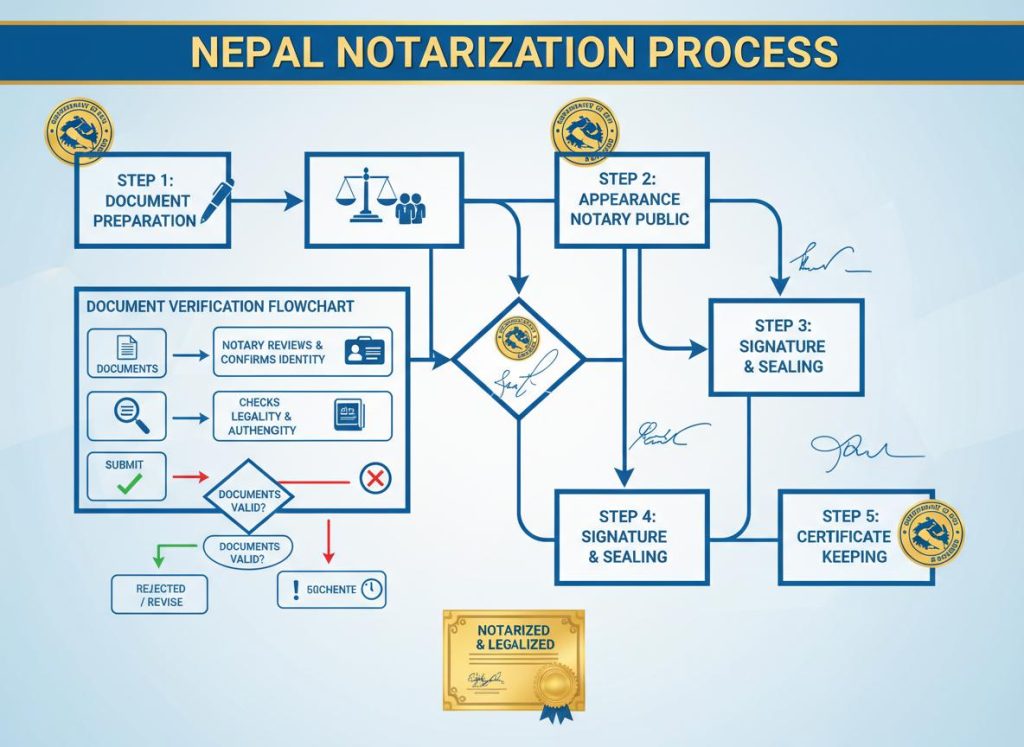
Info-graphic process chart of notarization in Nepal
For detailed guidance on document preparation and notarization procedures, explore the resources available at Kiplan Law.
Warning: The ‘Online Notary’ Myth in Nepal
IMPORTANT LEGAL NOTICE: There is a rising trend of websites offering “24/7 Online Notary” or “Seamless Digital Notarization” in Nepal. This is a legal impossibility under current Nepali law.
Expert Legal Opinion
The Notary Public Act, 2063 does not permit online notarization services. The Code of Ethics and current regulations explicitly mandate physical appearance before the notary. Any platform claiming to offer 100% remote notarization for Nepali documents is likely operating fraudulently or will result in documents that are rejected by embassies, government offices, and international institutions.
For authentic notary services in Kathmandu, always ensure the practitioner provides their full office address, contact details, and valid NNPC registration number. Authentic advocates and notaries will never hesitate to provide their credentials for verification.
Duties, Responsibilities, and Legal Limitations
A Notary Public in Nepal acts as a “public witness” to document execution and authentication. However, their power has specific legal boundaries that both notaries and clients must understand.
Core Duties of a Notary Public
- Neutrality: A notary cannot notarize their own documents or those belonging to close relatives, ensuring impartiality in all transactions.
- Integrity: Notaries cannot alter the content of a document; they only certify its authenticity, proper execution, or accurate translation.
- Record Keeping: Notaries must maintain detailed records of all transactions for at least five years as mandated by Section 12 of the Act.
- Verification: They must verify the identity of all signatories through government-issued identification documents.
- Compliance: All notarizations must comply with the Notary Public Act, 2063 and the Notary Public Rules, 2064.
Frequently Asked Questions (FAQs)
Is an Apostille available in Nepal?
No. Nepal is not yet a member of the Hague Apostille Convention. For international use, documents typically require notarization, followed by attestation from the Department of Consular Services (Ministry of Foreign Affairs) and then legalization by the relevant embassy of the destination country.
How much does notarization cost in Nepal?
Fees are regulated by the Nepal Notary Public Council. Standard attestation is affordable (typically NPR 500-1000 per document), while complex legal translations are charged based on the technicality of the text and word count. Commercial documents may attract higher fees.
Can a Notary provide legal advice in Nepal?
In Nepal, Notary Public are qualified lawyers, experienced lawyers (Advocates) with extensive legal practice. While they can provide legal counseling in their capacity as advocates, their role as a Notary Public is strictly limited to certification, attestation, and translation of documents.
Why was my notarized document rejected?
Common reasons for rejection include:
- The notary’s license has expired or was revoked
- The physical presence rule was bypassed (online notarization attempted)
- The document lacks the mandatory registration number or QR code
- The notary was not authorized for the specific type of document
- The document was not properly pre-verified by relevant authorities
- unable to verify concerned person or untraceable document.
What is MOFA attestation and how does it relate to notarization?
MOFA (Ministry of Foreign Affairs) attestation, conducted through the Department of Consular Services in Tripureshwor, Kathmandu, is the final government authentication step. Such attestation is made only to those document issued local authority of the Government of Nepal. the MOFA never attest of confirms any documents attested or translated by any notary public.
I found a number of professional looking websites which offer ‘Online Notary’ but there is only contact number, no notary/advocate profile, no proper official address. Where can I confirm this?
Not only website, but you may find such professional in Facebook, Instagram. If you are looking for Notary Translator then visit Nepal Notary Public council (NNPC).
Click the link: https://notarypublic.org.np/english-renewed-translators/. Alternatively you may visit KIPLAN as well and cross-check / confirm to quench your thirst.
Conclusion: Protecting Your Legal Standing
The Notary Public Act, 2063 is the cornerstone of legal trust in Nepal. By following the regulated path and avoiding fraudulent “online” shortcuts, you protect your legal standing and ensure your documents are accepted by embassies, universities, employers, and government authorities worldwide.
Always verify your notary’s credentials, ensure physical presence during notarization, and follow the proper attestation chain for international documents. When in doubt, consult with qualified legal professionals who can guide you through the process with integrity and expertise.
Need Professional Notarization Services?
For professional notarization, legal consultation, and document attestation services in Kathmandu, connect with qualified notary lawyers who prioritize your legal security with 100% integrity.
For more information about Comprehensive Legal and Business Solutions in Kathmandu and Professional Notarization and Legal Services: visit Kiplan Law. your trusted partner in Kathmandu, Nepal.